

Hand & Foot Remastered

Hand & Foot is a jazzed-up variant of the classic card game Canasta, which itself a variant of Rummy. It's a game where players are scoring by laying down sets ('melds') of at least three cards with the same rank, with bonuses scored for 'books' of at seven cards.
Whereas Canasta uses standard playing cards, Hand & Foot is played with its own special packs of cards. There are no suits but each deck contains four cards of each rank 4 through to Ace plus two red and two black 3s. Cards of rank 4-7 have a scoring value of 5 points per card; 8-King have a value of 10 points; Aces are worth 20 points. Red 3s are worth 100 points played singly but black 3s are worth -100 points, so you'll always want to discard them. Some wild cards have a value of 20 points and others 50 points; they can only be used as part of a 'book' of seven or more cards, and they must be in a minority on that book. A book that has no wild cards is called a 'clean book' and one that contains one or more wilds is called a 'dirty book'. This then must be the only card game involving 'dirty books' that doesn't need to ring your HR Department's NSFW (Not Safe For Work) alarm bells :-)
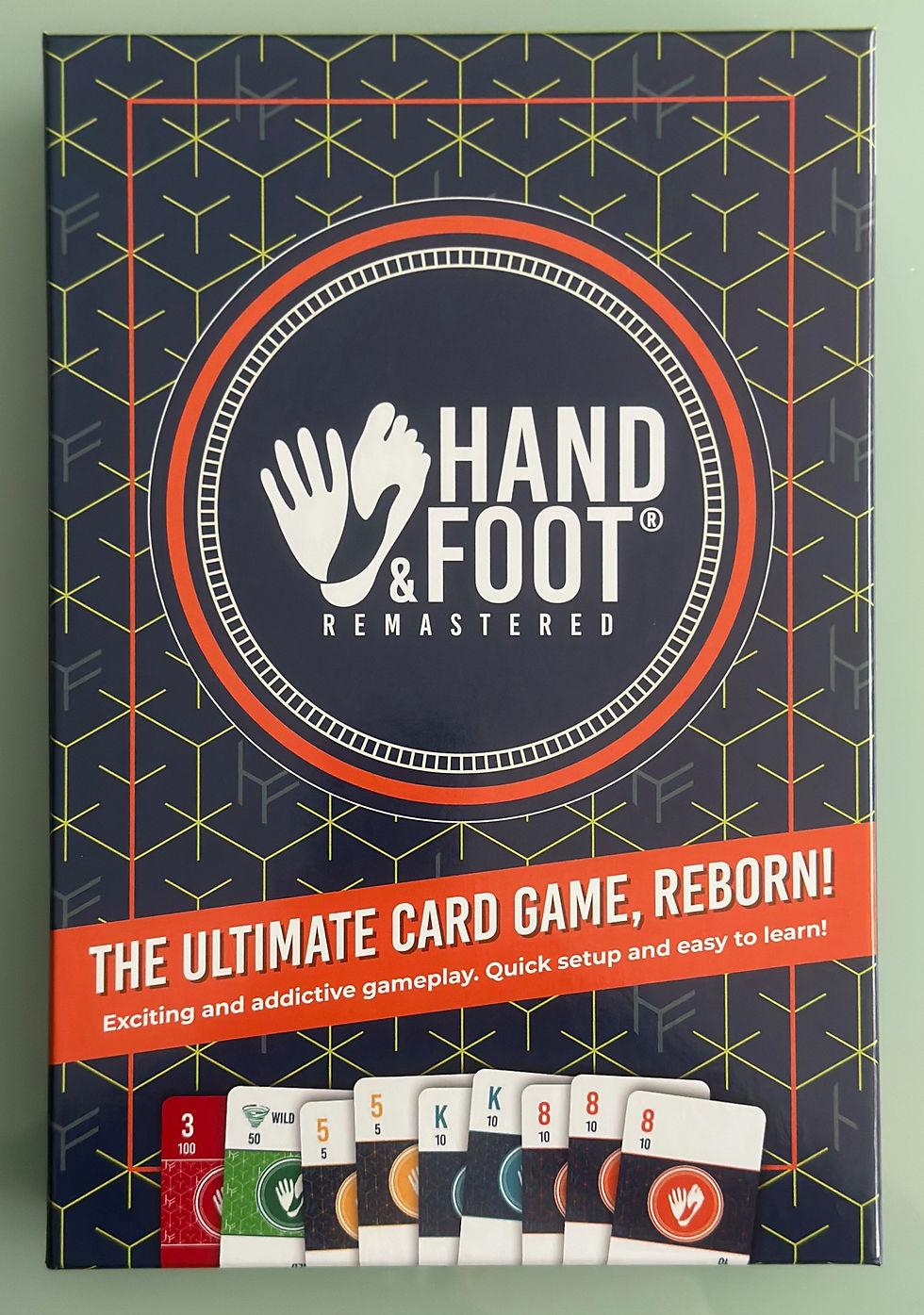
The game is played over four rounds using one more deck than the number of players, so the Remastered box for up to four players contains five packs of cards. You could increase the player count by adding more decks: two Remastered boxes would let you take the player count up to nine players, which is the number accommodated in the score pad that comes in the box.
The cards are all shuffled together to form a giant draw deck. Players first task is to each take a bunch of cards from the shuffled deck and divvy them out into two stacks of 11 cards. If, through chance or skilled estimation, a player has taken exactly 22 cards for their stacks, they immediately earn themselves a bonus of 100 points. Otherwise any shortfall or overage is taken from or returned to the draw deck. Of the two stacks, one becomes the player's hand and the other is passed to the player on their left as their 'foot'. Since the cards were previously shuffled and have only been counted out face down we were puzzled as to why players couldn't keep their own 'foot' stack, but them's the rules.
On your turn, you draw two cards and discard one. You're obviously trying to make melds but you can't lay any down to the table until you have melds with a total value that satisfies the requirement for the round: 60 points in round 1, rising by 30 points per round - so you can't lay any cards down in round 4 until you can rack up a total of 150 points, which is no easy task. When you've played to the table all the cards in your hand, you pick up and continue play with your 'foot' deck. To end the round, a player needs to have gone out completely (both hand and foot) with at least one clean and one dirty book. At this point all players score for the value of the cards in their melds and books, plus their book bonuses, but less the value of all the cards they have left in their hand and foot...
You can pick up a card from the top of the discard pile to add to melds you've previously played to the table (tho' not to complete a 'book') so as the game develops players will need to be increasingly wary about which card they discard. In our plays at Board's Eye View we've found that tho' luck is a inevitably a factor, winning tactics more often than not come down in the early part of the game to keeping a mental track of what discards the next in turn is picking up or ignoring, and then - when cards are on the table - being sure to avoid offering them discards that they can use to develop the sets they've laid down.
Hand & Foot then is a light, easy-to-play, family-friendly set collection card game. The escalating round requirements keep the game interesting even for players who have fallen behind in previous rounds: if you manage to put together 150 points worth of melds sufficiently ahead of other players, you might catch other players out with a big negative final round score so that you could come from behind to still steal a win.
The game is attractively presented by Gray Dog Games (aka Grey Dog Ventures). We like the way the cards all show their individual points value below the card rank number. Our one gripe is that the ranks and values only appear on the top left/bottom right. That's fine for right-handed players but left-handers more naturally fan cards the other way around. If you're playing with any left-handed players who struggle to fan the cards in their hand, you may need to find them a card rack.
Oh, and if you want to really shake up your games of Hand & Foot, Gray Dog Games have also published an Action Pack containing a deck of cards that alter the rules or otherwise disrupt routine play. The Impact cards alter the game requirements or scoring of 'books' and melds (for example, demanding eight cards for a 'book' rather than the usual seven). Action cards can reverse the direction of play or require players to miss or repeat a turn; there's even a card that imposes two missed turns on the next player who looks at their phone :-) Finally, there are Attack cards that let players screw with each other's hands and even their completed 'books'. The idea is that you apply a different Impact card each round and you shuffle a few Action and Attack cards into the decks according to taste. We confess we've become Hand & Foot purists so we much prefer the vanilla game but an Action Pack certainly makes for a chaotic variant for those who like to change things up.


