

Flora Funga

With Flora Funga, Outset Media are giving us two games in one. Tho' both use the same fold-out board (which magnetically fits around the box when packing the game away), there are two separate games; one themed around plants and the other around fungi. There are some similarities in that both the games involve the 2-4 players placing out pieces and scoring for patterns but the differences between the two games aren't just over the taxonomic kingdoms and phylums of the pieces you're placing out.
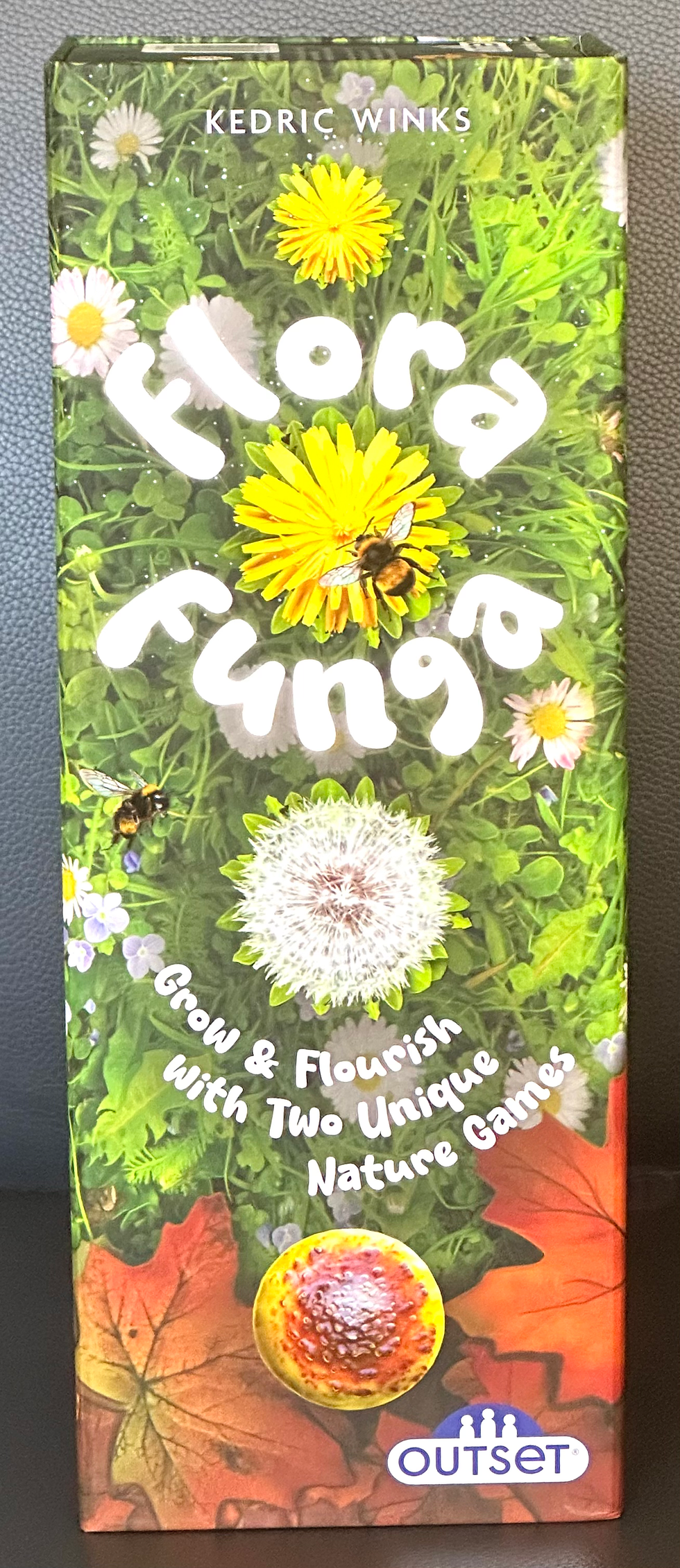
The Flora game is themed around dandelions. A dandelion comprises the plant, bud, flower and seed head, and players take turns placing out any piece of their choice on the board. As the game progresses and their bee markers advance along a track, players will be able to place out two or three pieces on a turn. A plant can have up to five buds on it, each bud can have a flower placed on it and each flower can have a seed head on top.
Following an initial round of card drafting, players each assemble a hand of eight mission cards. These show the patterns that need to be created; for example, two flowers on a single plant. You score and discard a mission immediately you spot a pattern that matches the one depicted on the card, regardless of who placed the pieces making up the pattern. The game is won by the first player to get rid of all of their mission cards.
Because Flora games start with card drafting, where you take a card and pass the remaining cards on to the player to your left, you get to see the majority of mission cards, so players with an eidetic memory will always have a distinct advantage since they'll have a very good idea of what patterns will allow other players to score their cards. The rest of us ordinary mortals tho' will probably not remember all the cards we've seen and will just focus on creating and looking out for the patterns that we need to satisfy our own mission cards. Indeed, some players may even find it difficult keeping track of their own eight cards because you want to keep them concealed from opponents but you can't easily fan them in a hand. If that's an issue, you will just need to deploy card racks.
In Funga, players have a randomly allocated asymmetric ability and each gets dealt four mission cards from which they choose three. In this game players are placing out one piece each turn from the five stacks of different size fungi, some of which have spiders shown on them. Each player's mission cards are placed out face up so that all players can see them, and they score the number of points indicated on the card every time that card's pattern appears. Some missions demand visible spiders but most do not. In this game, the bee track is treated as a score track.
Funga is a step up in complexity from Flora. The mission cards use algebraic notation to indicate the scoring pattern; so, for example, a card might show a set of three touching circles labelled X, Y, Z - meaning it scores whenever three different mushrooms are touching. Choosing three out of four randomly dealt mission cards means players only have a small degree of choice over what they will be scoring for, and it can mean one player gets a 'better' or easier-to-score set of cards than others. If you find that becomes an issue it's easily ameliorated by adopting a similar initial card draft, as in Flora. Indeed, it seemed to us that card drafting was even more appropriate for Funga than for Flora.
Several of the patterns in Funga are a little more complex than those in Flora and in our plays at Board's Eye View some players found it harder to spot the patterns, especially as the same mission card can be claimed multiple times as more fungi are placed out. Funga tho' is the more strategic game and, of the two, it's the game that offers the most deliberate rather than accidental interaction.
Both Flora and Funga play quickly; most of our plays at Board's Eye View have come in at around 15-20 minutes, so this makes for a versatile games night filler. And Outset Media have put it together as an attractive package. It's a safe guess that, in designing the game, Kedric Winks originally envisaged that the tokens would be reversible so that Flora tokens had a Funga on its reverse side. That would have saved some money on the manufacturing costs but Outset Media have thrown caution to the winds, along with those dandelion seeds, and given us completely independent standalone sets of tokens for both Flora and Funga.


