

The Terror, Paris 1793

It was the best of times, it was the worst of times, it was the age of wisdom, it was the age of foolishness, it was the epoch of belief, it was the epoch of incredulity, it was the season of Light, it was the season of Darkness, it was the spring of hope, it was the winter of despair, we had everything before us, we had nothing before us, we were all going direct to Heaven, we were all going direct the other way—in short, the period was so far like the present period, that some of its noisiest authorities insisted on its being received, for good or for evil, in the superlative degree of comparison only.
Charles Dickens' long opening sentence to A Tale of Two Cities sums up the aspiration, despair and turmoil of the French Revolution. And the French Revolution is the subject of Brickwork's card game The Terror.
Most of us think of the French Revolution as a simple binary contest between the citizen revolutionaries and the ancien regime of the aristocracy but the citizenry was divided into factions, each of whom saw the others as 'enemies of the people'. We're all familiar with the guillotine but of the 17,000 executions in Paris during the Revolution, less than 10% were of aristocrats; most were ordinary people - shopkeepers, artisans, peasants - denounced for 'speaking ill of the Revolution'. And as France descended into Civil War, political activists denounced each other with increasing fervour - feeding the guillotine with the blood of their political rivals.
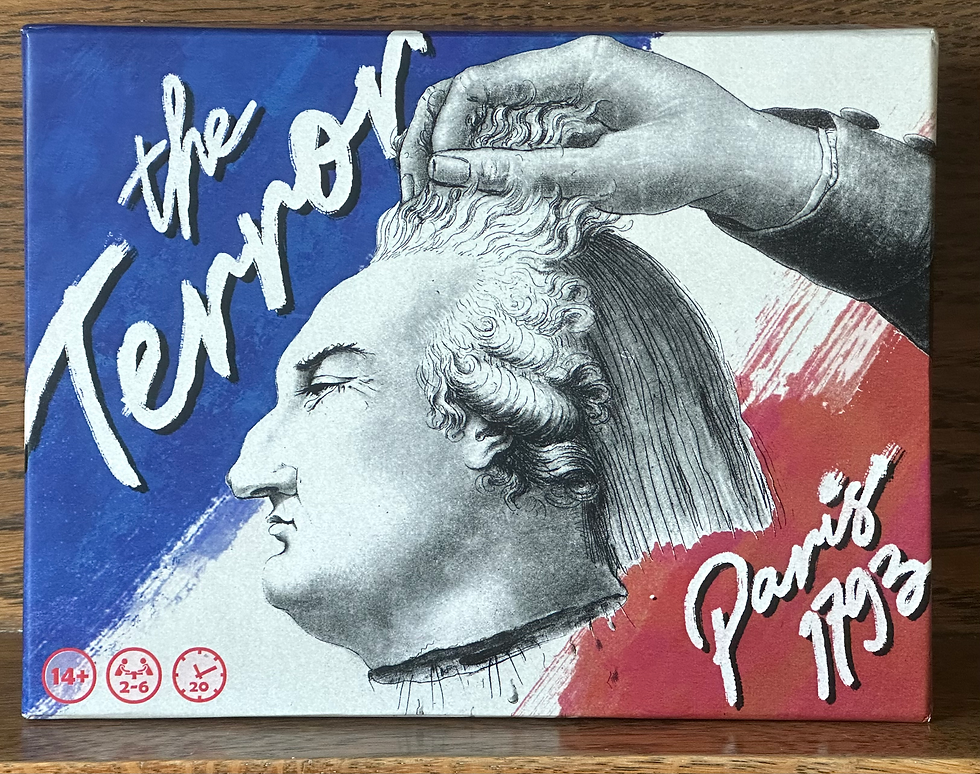
The Terror is a game for 2-6 players played over five rounds. Players are each dealt a Conspiracy card that sets them a secret objective. You play with a deck of Citizen cards and a deck of Terror cards. Each of the Citizen cards depicts a historical figure from the period. They are divided into six factions: Montagnard, Cordelier, Feuillant, Girondin, Ultra-Radicaux and Bourbon. Most players will identify each faction simply by colour (or symbol, if you're colour-blind). The game has been designed by very knowledgeable history buffs so all the Citizen cards give plenty of biographical detail but for the purposes of gameplay you really only need to know each card's faction and the number of stars on the card (1-3). The Terror deck comprises cards depicting the guillotine, masks and votes (1-3).
Each turn, a player draws three Citizen and two Terror cards. They must play one Citizen card to their own tableau, one to the tableau of another player and one straight to the guillotine. If you play a mask card, you can play one of your Citizen cards face down so that only you know who is being added to a tableau or sent to the guillotine. A guillotine card may be played to execute a Citizen already in your own or another player's tableau but unless it is a face-up one-star card, you'll need to play additional votes for the execution. Vote cards can be used to 'swap' a Citizen between tableaus. They can also be discarded to temporarily protect a Citizen from being guillotined or swapped.
After five rounds, masks are removed (face-down cards flipped face up) and all the cards that were sent to the guillotine are sorted into their factions. Bourbons (the French royal family - not the biscuits!) are ignored but the factions are ranked by the number of stars. The faction with the fewest stars is the most successful at surviving the Terror; players score double for all the stars on the cards of that faction in their tableau. The next two factions score positive points: 1 per star. You score a negative point per star for any Bourbons in your tableau and for any cards in the factions that were in 4th and 5th place (ie: those with most stars guillotined). Finally, players reveal their Conspiracy cards; these mostly award a further 3 points if the objective has been met.
The theme might be macabre but The Terror is essentially a party game. The end-game scoring means there's a strong memory element as players try to keep track of which faction has the most and the fewest stars in the guillotine pile, but with judicious use of mask cards you can keep even hardened card counters on their toes. The game shines at four or more players but it plays briskly even with a full complement of six players.
Shown here in our Board's Eye View 360 is a preview prototype of the game ahead of its Kickstarter launch on 9 June. All the artwork on the tarot-sized cards is licensed from the museums and galleries where the portraits of the various citizens hang, but Brickwork promise that the version of the game that goes to backers will feature more blood! :-) We'd like to see a round tracker included on the board and there's scope for improving the Conspiracy cards. These are almost all worth the same 3 points but they vary hugely in difficulty: it's considerably easier to fulfil an objective that simply requires a particular named Citizen to be guillotined than it is to ensure that a specific faction ends up with negative points. In practice, you're unlikely to find winning or losing depends on those 3 points but it would be better if players were given a choice of Conspiracy cards, and with killing cards worth fewer points than faction placement cards.
The preview prototype that we've been playing has only five mask cards but the more we played the more we wanted to be able to play face-down cards to each other's tableaus and to the guillotine. Members of the Board's Eye View team experimented with a house rule allowing Vote cards to be used to mask and unmask cards (two votes for a mask/unmask action). It's an option that's definitely worth a try.
However you play, The Terror is a lot of fun, and it plays in a filler-length 20-30 minutes. And if you read just some of the flavour text as you play then you're sure to leave the table knowing a more about this bloody period of French history than before you started. Click here to check out the Kickstarter.
(Review by Selwyn Ward)
#TheTerror #Terror #FrenchRevolution #cardgame #guillotine #partygame #Brickwork #takethat #memorygame


