

Rising Cultures

Designed by Aske Christiansen and Francesco Testini, Rising Cultures is a two-player civ card game, tho' there are four different civilisations to choose from so that makes a total of six different potential pairings in the box. In addition, the provinces over which you're competing are randomised each game (you use seven of the 15 possible cards), so there's a lot of replayability baked into this box from Capstone Games and Huch. A province is won by the player who has the strongest military at the end of each round, so the provinces placed out at setup also function as the game timer, marking off its seven rounds.
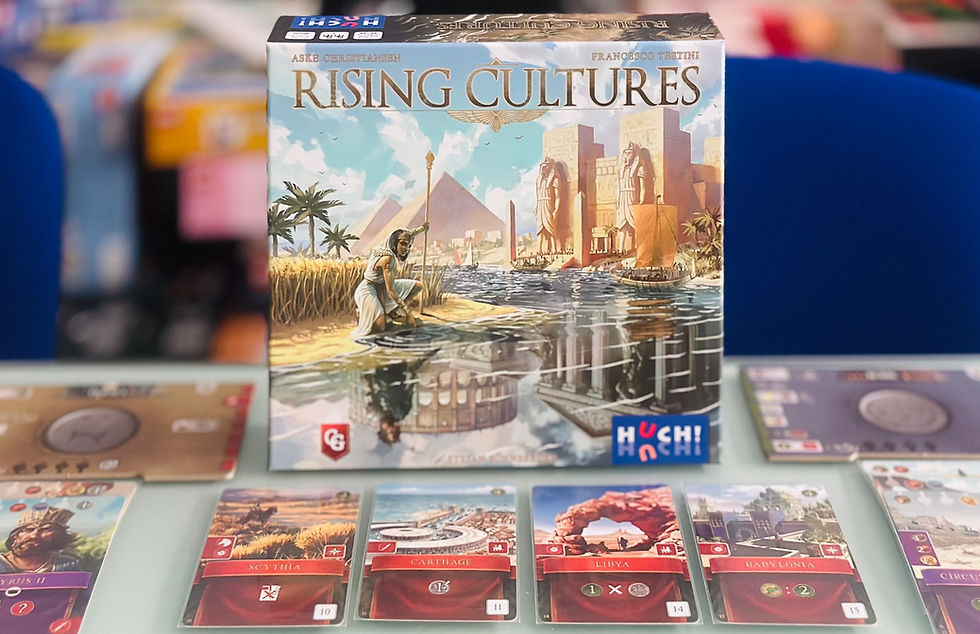
Each civ has its own unique deck of 24 multi-use cards (27 if you're playing as Egypt) and its own asymmetric power which crucially impacts on that civ's playing style and is bound to give a particular spur to the best tactics to deploy. Players initially draw four cards from their deck and, from those, they must place one on top of their draw deck, one on the bottom of the deck and two to utilise solely for their core resources. That means you'll be using those two cards at the cost of taking them otherwise out of play, so you won't later have the option of benefitting from their cards effects.
In subsequent rounds, players draw four cards and decide how to use three of them (eg: for their resources or their effects) and place one back on top of their deck where it will be drawn next round. To use a card for its effect you'll usually have to meet specific conditions; for example, having particular resources, or you may need to pay for its continued upkeep. Cards can also be inverted and used to strengthen your civilisation's military power (needed to conquer provinces) or discarded for coins. Players also have the option of flipping their topmost (most recently played) resource card and utilising it to progress their civilisation. This will usually boost subsequent actions; so, for example, the first time the Persians do this it gives them the ability to swap a card and to place their unplayed card each round at the bottom rather than the top of the deck.
You've a plethora of choices for how to use each card, and canny combos can be especially productive so that certain deployments can give you two or more benefits from the same card. For example, you might allocate a card to resources, make use of it and then consign that same card to your civ's progress track. Because you're routinely playing one of your cards to the top of your draw deck, you know one of the cards you'll be drawing next round so can use cards to set yourself up to be able to benefit most from that card. Weighing up all these options means that this is a game that you should avoid playing with anyone who suffers overly from AP (Analysis Paralysis). Provided neither player has AP, you can expect Rising Cultures to play quickly because players are simultaneously drawing and choosing how to use their cards. Our plays at Board's Eye View have mostly come in around 40 minutes. The similar theme inevitably invites comparisons with Imperium: Classics (Osprey Games), which is also a civ card game usually played as a two-player head to head, but they are actually very different games. Of the two, Rising Cultures is the easier for new players to learn and play.
With art by Stefan Sonnberger, Rising Cultures is attractively presented, and it delivers a lot of game in a commendably modest sized box. And if you enjoy the game as much as we have, you can look forward to the prospect of Capstone Games releasing expansions that offer further classical civilisations to add to the mix.


