

Fathom

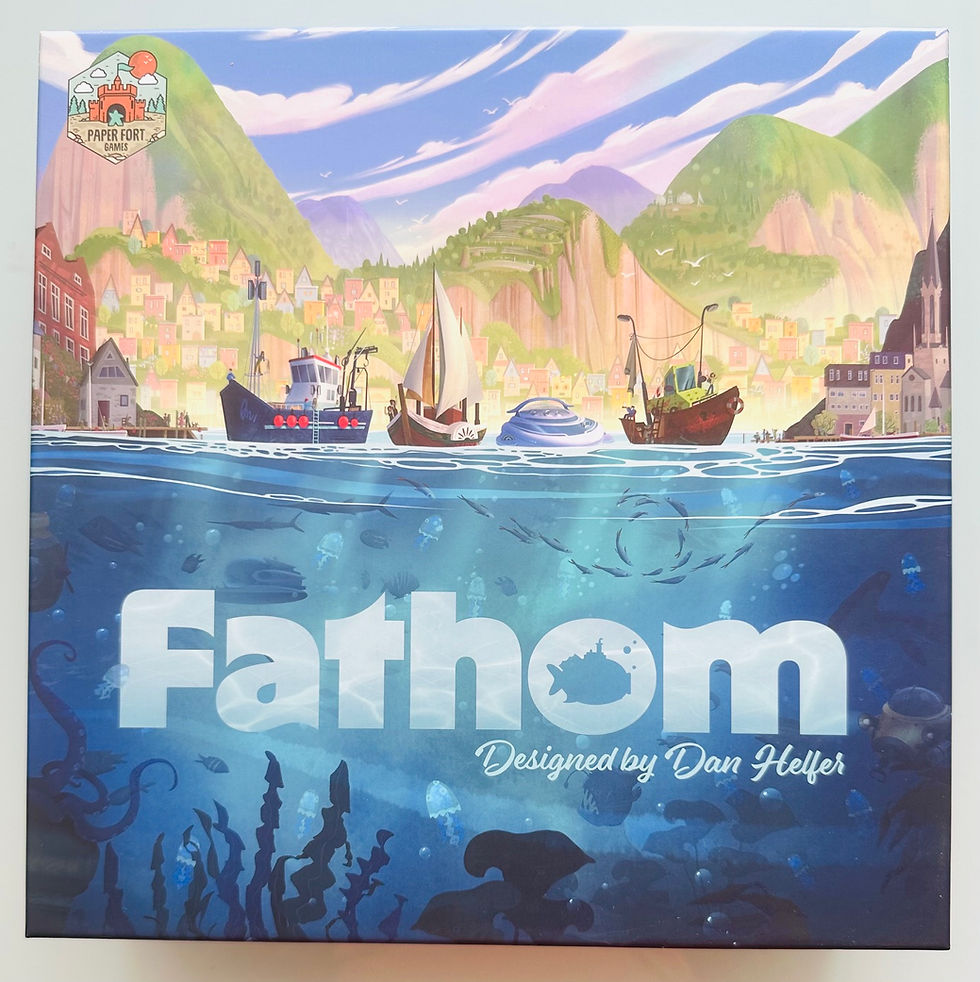
Designed by Dan Helfer, with attractive art from Ekaterina Boguslavskaya, and published by Paper Fort Games, Fathom is a tile-laying pattern building game where the 2–4 players score for the various sets of marine tiles on their own and other players' boards. Each type of tile has its own scoring criteria and much of the game involves tile manipulation to maximise the scoring of your own coloured tiles.
The game is played over six rounds, with multiple actions per round, but a guide - nattily disguised as a levered control panel - walks players through all the actions, and in appropriate order. Some of the actions can be taken simultaneously rather than in 'turn order' and that helps to keep gameplay brisk, so you can play the game in under an hour - even with a full complement of four players.
Through the course of the game, players will be moving their ship and submarine around their individual boards, placing out tiles from their own and other players' bags, initially face down but with tiles under your ship flipped to their 'discovered' (face up) side. Players will also be collecting tiles from a shared central board on which they place out their radar scanner. It's really only the scanner placement where turn order matters: the player who goes first has completely free choice of placement and the player who goes last that round is given Hobson's choice.
Tho' gameplay is straightforward, the different scoring requirements of each of the marine tiles can present a challenging optimisation puzzle because some requirements will conflict with others. Tho' moving tiles is among the submarine actions you get to take each round, every time you use a submarine action to move a tile it's likely to be at the expense of another action that you're keen to take... That's quite literally part of the depth of this game.
Paper Fort Games have done a beautiful job in the production of Fathom, and it's a game that comes packaged with four different 'expeditions' (sets of additional tiles with their own distinct scoring). The changes between 'expeditions' helps keep the game fresh on each replay. Most do so without adding complexity, tho' Expedition 4 (subtitled, Standoff in the Shadows) is a noticeable step up in difficulty because it's played on a slightly different player board (the flip side of the regular board) divided into sectors, and with sharks that hunt and consume stingrays in the same sector of the board. Every time a stingray on your board falls prey to a shark it effectively costs you 2 points.
#Fathom #PaperFort #PaperFortGames #tileplacement #patternbuilding #setcollection #puzzleoptimisation


