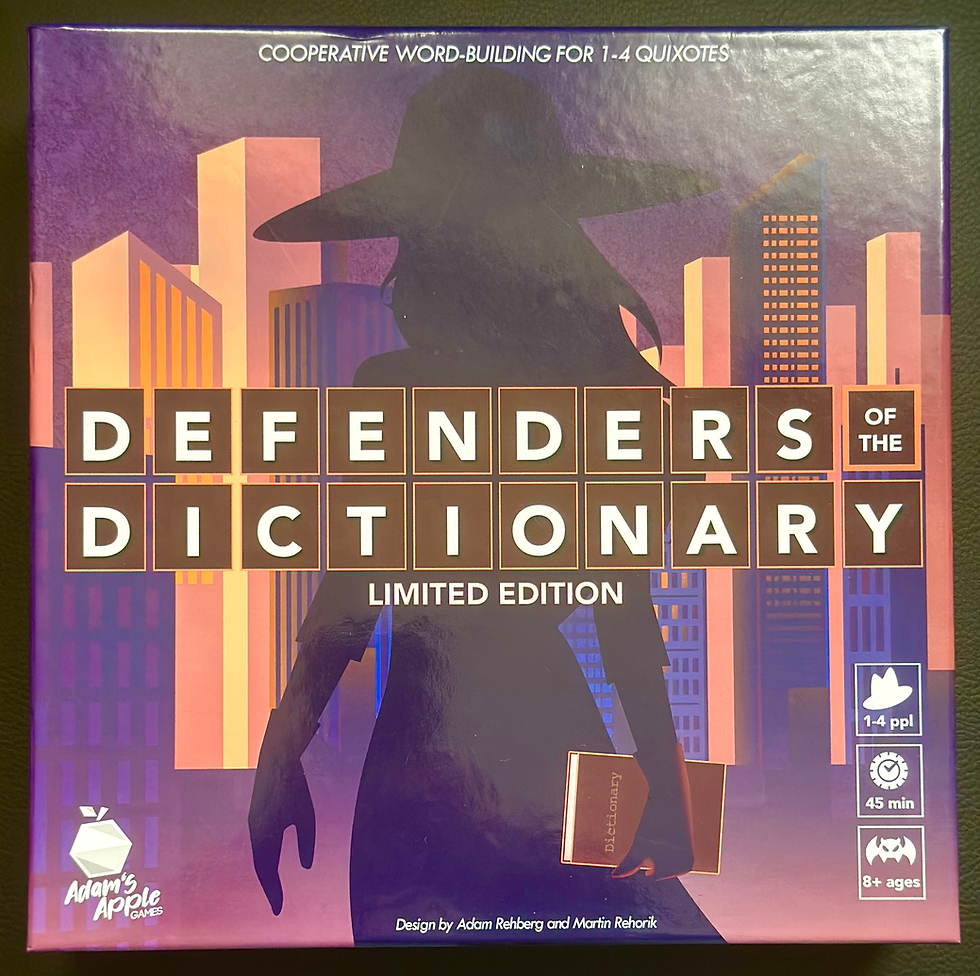
Defenders of the Dictionary

It's lucky Adam Rehberg is the founder of Adam's Apple Games because this must otherwise have made for an implausible pitch from him and co-designer Martin Rehorik: a cooperative Scrabble-like word game where the 1–4 players are defending their city against super-villains!
You play scenarios, either individually or linked together as a campaign game, forming the playing board from various different combinations of the five double-sided playing mats. These create a cityscape grid that is similar to a pair of Scrabble boards except that there are no double-letter or double-word squares; instead there are areas blocked off by 'buildings' and other obstructions. Depending on the scenario there will also be tokens that need to be collected - in order, in scenarios where they are numbered - by laying words over them, and there may be 'Ding-a-Ling' creatures blocking key spots on the board. The critters only move when you use a letter in their name, and in some scenarios you need not merely to get them out of the way but to trap them (surround them so that they cannot move).
Players each have their own identical bag of individual letter tiles. These don't contain every letter of the alphabet - just more frequently used consonants and multiples of vowels. There's also a bag of tiles for the villain - a non-player character. The villain's bag contains all 26 letters of the alphabet, tho' some tiles are removed at random for particular scenarios. Each turn, a letter is drawn from the villain's bag and is revealed to the players who must then each contribute one or two letters from the five they've drawn to their rack (one letter each in a three- or four-player game; two letters in a solitaire or two-player game). Players mustn't disclose what letter tiles they have and should avoid editorialising with comments like 'it would be nice if someone could play a G' but once everyone has played their letter(s), initially face down, the tiles are flipped face up and players can discuss what words they can make and where best to place them. The word that's played must use the villain's letter or it is discarded and that letter's value is deducted from the players' score. The villain's bag also functions as a game timer because players need to have met their scenario's specific victory conditions before the tiles in the bag have all been used or discarded.
The crossword word placement mirrors Scrabble rules, as do the letter tile values (our preview copy had the K with value 1 but we assumed that was a mistake and it should've been 5). You collectively score for the words you place out. What distinguishes Defenders of the Dictionary from Scrabble and other crossword games is that you need to plan out how you can build words to reach the various tokens you need to collect, which can be tricky due to the obstructions in the grid. Player tiles that aren't used can mostly be carried forward to be used on another turn, so a canny group of players will plan ahead so that they have a plausible prospect of building their next word out from the words already played. In this game it will often be better to place out a lower scoring word in order to open up a path that better helps you reach a target location on a later turn. Competitive Scrabble players are generally wary of opening up the board for an opponent but in this game you are working together so it's always good to open up the board and make it easier to navigate around the obstacles.
Each scenario doesn't just have its own set-up but also includes a rule addition or tweak; for example, when introducing the Ding-a-Ling creatures and how they move and are captured. Rather than creating an off-puttingly bulky rulebook, Adam's Apple Games have all these additional rules printed on separate numbered cards so you just lay out the cards with the applicable rules depending on the scenario you are playing. Simples!
In our plays at Board's Eye View, we've found the cooperative discussion and planning tends to focus more on optimising placement over word scores, especially in those tough scenarios that demand hitting locations in a specific order. Hitting a scenario's required word score was rarely an issue, to the extent that we toyed with upping the required total as a way of stepping up the difficulty for more experienced players. We did that in games with just two players because being able to contribute two tiles rather than one makes the two-player game noticeably easier than the three- or four-player game; less so the solitaire game because there the two letters contributed by the dummy player are drawn at random.
Defenders of the Dictionary is currently live on Kickstarter. Click here to check it out. The 'Scrabble with super-villains' premise may sound bizarre but the game works surprisingly well and offers a tense cooperative challenge.
#DefendersoftheDictionary #AdamsAppleGames #wordgame #strategy #crossword #Scrabble #cooperative #solitaire #solo #supervillains