

Aspens
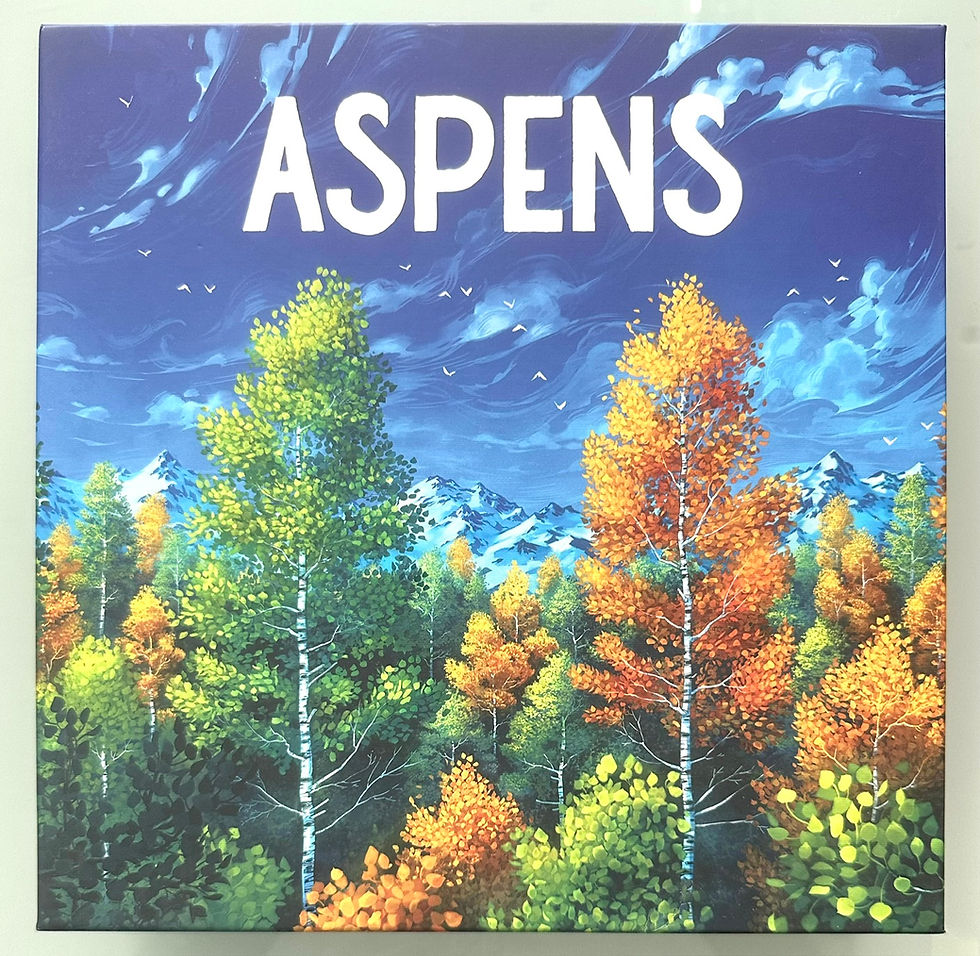
I’m one of those people who can be seduced by a beautiful game, tho' I love ugly but great games as well - I’m looking at you Land and Freedom (EdicionesMasQueOca). And seduced I was by the simple but stunning box design of Aspens (Ludivore Games) and its equally pretty parts. The game is designed by Neil Edwards and Luke Roberts, and the art is by Kaitlin Brasfield.
The premise of this two-player game is simple: make your tree species the dominant tree in the forest. What really delighted me was the alignment of the theme and the mechanics. The game starts at three watering holes scattered around the forest and you try to increase your coverage from there. On your turn, you roll two dice: one determines how many new trees you’re going to get and the other determines the direction of the wind.
In each round, both players receive trees, but the current player gets an extra one and only they can place their trees on the board. This part of the game gives you the big dilemma: you can either increase the number of trees on one field or put a tree on an adjacent field. The tension comes from the fact that you want to expand your trees but the die roll that determines how many trees you get is dependent on the fields that have more than one tree. The die has values from 2 to 7: you get one tree for every field where you have at least that number of trees. So if you roll 4 and you have five fields with one tree and one field with 4 trees, you get an extra tree (plus 1 if you are the current player).
So the tricky thing is to find the balance between increasing the density of your forest (thus making it more likely to get more trees in future) and increasing the size of the area you are controlling, because that is where the other die comes in. You roll a wind die which tells you the direction in which your tree seeds travel and therefore the direction in which you can plant more trees. If you roll East, for example, you can move towards East, Northeast and Southeast, which gives you a fair amount of leeway.
If you manage to block off an area completely with your trees, that area becomes permanently yours and you have the delightful task of immediately placing your trees there.
Aspens is one of those games that takes time to get going, but as you start to have more and more fields with multiple trees, getting more and more trees and thus conquering new areas becomes easier and faster. The momentum slowly builds and then suddenly ends in the crescendo of a final turn when the final bits of remaining empty areas are covered (as long as you roll the right wind direction…) and the game suddenly comes to an end.
There is no catch-up mechanism, which I quite like and isn’t a problem as long as both players have similar levels of experience. And even if someone seems to be falling behind, the game plays pretty quick at around 30 minutes so doesn’t overstay its welcome. On most game nights, you’ll probably have time for a quick rematch.
Overall, Aspens is a lovely game with a very thematic mechanism and it is very easy on the eye, which, to me at least, is a big bonus.
(Review by Balint Hamvas)


