

Acornism

Designed and illustrated by Kotori, and published by PhantomLab, Acornism is an attractive tile-laying game for 2-4 players where the players are placing their tiles within an emerging 8 x 8 grid. The tiles are all domino-like, with one end showing a number of acorns (0-4) and the other showing a cute but hungry animal who needs 5-10 acorns to fill them up.
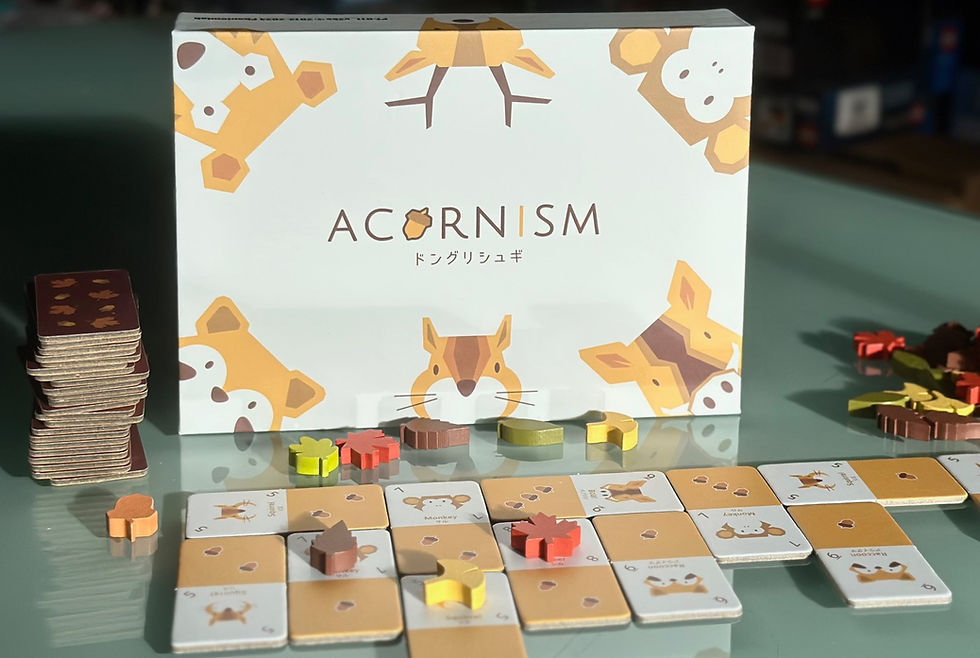
Play is super simple. From your hand of four tiles, you place one so that its acorn end is orthogonally adjacent to an animal and/or its animal end is adjacent to acorns; you can't place a tile with adjacent animals or adjacent acorns. In this way, animals other than at what becomes the edge of the shared 8 x 8 tableau can all be surrounded by four acorn squares. The number of acorns surrounding an animal cannot exceed that animal's appetite number and you cannot place a tile so that it surrounds an animal with fewer acorns than it requires. Whenever you place a tile to completely surround an animal with the exactly correct number of acorns, you place one of your markers on the animal. At the end of the game, the player with the most markers wins the game.
Acornism is a light family-friendly game that's attractively produced, with players' markers in different shapes representing leaves and cones. It can be played by quite young children for whom the arithmetic practice can be educational. As the tableau fills, there's some puzzle-solving involved in optimising your tile placement, and it's even possible for a single tile placement to score for more than one animal, but adults will quickly realise that play mostly involves avoiding as much as possible surrounding the third side of an animal where an opponent has what's needed to complete the fourth side.
The rules envisage playing with open 'hands' of face-up tiles so you can always see what placements are available to your opponent. In our plays at Board's Eye View we tried, as a variant, playing with concealed hands. If you play in this way, it adds a strong push-your-luck element to the game, particularly with just two players. Knowing that I have in hand the acorn tile needed for its surround, I might play a tile to the third side of an animal, taking the chance that you don't have the precise acorn number tile needed to claim the animal a turn ahead of me. If my push-your-luck gamble pays off, I get to score the animal on my next turn.
Our 'house rule' concealed-hand option aside, PhantomLab include a variant of their own. The game comes with a custom six-sided die that has a different animal on each face. You incorporate it by rolling it at the start of the game to determine which animal is worth an extra point when scoring.
We prefer Acornism as a two-player game, particularly with our 'push-your-luck' house rule, but it's a game that's certainly playable with three or four children.
#Acornism #PhantomLab #tilelaying #childrensgame #familygame #educational #acorns #pushyourluck #dominoes


